
2022-01-18

文章导读
保护森林是减缓气候变化和保护生物多样性的主要目标之一。在此背景下,了解森林转型(FTs)的驱动因素非常重要,即从大规模砍伐森林到重新造林的长期转变。概念性工作主要集中在识别具体的 "森林转型之路",基于土地利用、社会经济或政策扶持过程。相比之下,社会资源利用相关变化的FTs最近才得以从社会生态学的角度研究,且很少与生态系统服务的变化相联系。
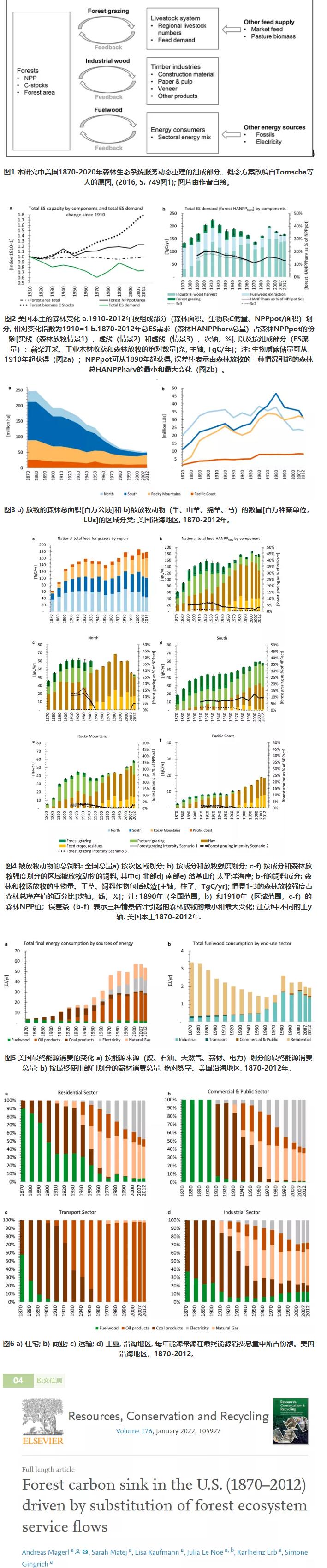
鉴于美国有丰富的森林史料和广泛的历史数据,这为长期研究森林变化和资源利用之间的相互联系提供了独特的机会。生态系统服务(ES)表示人们从生态系统中获得的实际(非)物质利益,包括供给服务(如饲料、木材、清洁水、纤维)、支持服务(如光合作用、营养循环、土壤形成)、调节服务(如碳封存、防洪)和文化服务(如娱乐、精神、审美)。此研究利用社会生态指标框架,调查了1870-2012年期间森林转型(FTs)在供应性生态系统服务(ES)方面的变化,并将其与森林部门以外相关资源使用的ES需求变化联系起来,即饲料和燃料使用的变化,揭示了长时间森林变化和资源使用之间的联系,有助于更好地理解FTs的可持续性影响。
原文摘要
了解森林转型背后的动态,即从砍伐森林到森林恢复的转变,对于森林保护和减缓气候变化至关重要。尽管工业木材开采激增,但美国的森林仍在增加,我们调查了此变化的驱动因素。我们采用人类对净初级生产力的占用(HANPP)和材料和能量流分析(MEFA)的概念来定量评估主要的森林生态系统服务的供应变化,即工业木材(包括用于造纸和纸浆等产品的生物质),生物质放牧和薪材,并在区域、部门和国家尺度上分析1870-2012年的替代过程。在此期间,工业木材在森林生物量年总采伐量中的份额从23%增加到84%,而薪材从63%下降到13%,生物质放牧从14%下降到3%。饲料和能源的转移减少了对薪材和生物质放牧的需求,从而增加了牲畜数量和能源使用。饲料作物增加了六倍,减轻了放牧对森林生态系统的压力,特别是在东部各州。化石燃料取代了薪材,尤其是在住宅领域。1900-2012年间,最终的能源组合增加了17倍。因此,美国森林生物量碳储量的增加与以化石燃料为基础的生产系统取代森林生态系统服务有关,并与社会资源使用和碳动态的多方面增加有关。在评估森林转变的积极环境影响时,需要考虑到这种转变。

Abstract
Understanding the dynamics behind forest transitions, i.e., shifts from deforestation to forest recovery, is crucial for forest conservation and climate-change mitigation i.e., carbon (C) sequestration. We investigated the drivers of the forest transition in the United States, which was characterized by forest thickening despite surges in industrial wood extraction. We employ the concepts of Human Appropriation of Net Primary Productivity (HANPP) and Material and Energy Flow Analysis (MEFA) to quantitatively assess changes in major provisioning ecosystem services demanded from forests, i.e., industrial wood (comprising biomass used in products such as paper and pulp), grazing, and fuelwood, and analyse substitution processes from 1870-2012 at regional, sectoral, and national scales. The share of industrial wood in total annual forest biomass harvest increased from 23% to 84% over the time-period, while fuelwood and biomass grazed declined from 63% to 13%, and 14% to 3%, respectively. Reductions in demand for fuelwood and biomass grazed were enabled by shifts in feed and energy sources, consequently allowing for increases in both livestock numbers and energy use. Feed crops increased six-fold, alleviating grazing pressure on forest ecosystems, particularly in the Eastern states. Fossil fuels replaced fuelwood, especially in the residential sector. Between 1900-2012 the final energy mix increased seventeen-fold. Thus, the increase in biomass C stocks in U.S. forests was connected to substitution of forest ecosystem services with fossil fuel-based production systems, and with manifold increases in societal resource use and C dynamics. Such shifts need to be considered when assessing the positive environmental effects of forest transitions.