
2021-10-15
文章亮点
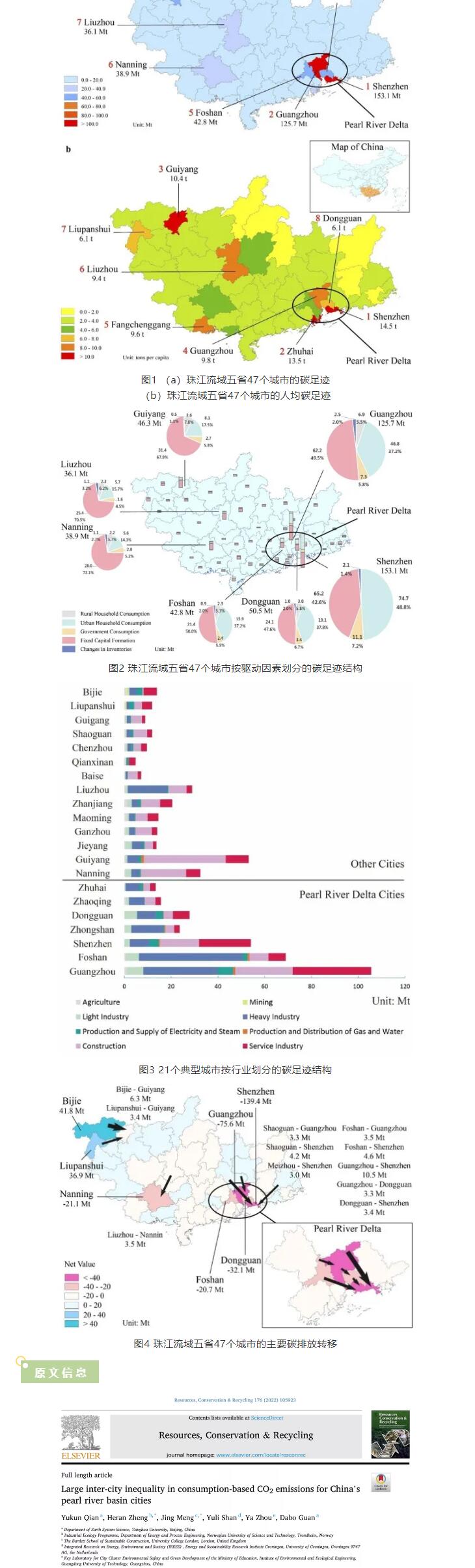
(1)珠江流域47个城市(占中国总人口15.9%)贡献了中国13.1%的碳足迹。
(2)珠江流域城市间碳足迹差距高达40倍。
(3)大型基础设施建设是各城市碳足迹最主要的驱动因素,42.1%-75.6%的碳足迹因此而产生。
(4)对建筑业、重工业和服务业的需求是80%以上的碳排放的驱动力。
(5)碳转移主要集中于省域之内,而上下游之间跨区域的碳转移并不显著。
文章导读
碳减排对于应对气候危机至关重要。城市作为人类活动的主要载体,承载了绝大部分的温室气体排放。目前,中国已然成为全球最大的碳排放国家,其城市碳减排进程关乎全球气候危机应对的成败。然而,中国城市之间在产业结构和发展进程方面存在巨大差异,这导致了城际低碳路径和碳排放责任的异质性。
目前,对中国碳足迹的研究大部分集中在国家和地区层面。由于缺少城市层面的多区域投入产出表,基于城市层面的研究仍有待进一步推进。珠江作为中国第三大河流,其沿线城市2012年GDP占比达17.1%,且一半以上来自位于珠三角地区的9座城市,流域内发展极端不平衡。本文运用多区域投入产出模型,对珠江流域47座城市的城际碳排放不平等进行了深入研究。
原文摘要
城市在碳减排中起着引领作用,但由于各城市的社会经济背景不同,其减排政策也大相径庭。随着城市之间的联系日益紧密,一份全面的碳排放清单对于不同城市碳减排政策的制定至关重要。珠江流域是中国重要的经济区之一,流域内城市之间存在巨大差异,而关于其碳足迹的现状研究非常有限。为了填补这一空白,本文制定了2012年流域内47个城市的碳足迹清单。研究发现,这47个城市的碳足迹总量为9.338亿吨,占中国碳排放总量的13.1%。城市之间的碳足迹存在巨大差异,河源市碳足迹最小,仅为0.036亿吨,而深圳市碳足迹高达1.531亿吨。流域内碳足迹高度集中,最大的七个城市的碳足迹之和占流域总排放量的52.8%。城市间人均碳足迹也存在较大差异,从人均1.2至14.5吨不等。对绝大部分城市而言,大型基础设施建设是主要的碳排放驱动因素,42.1%至75.6%的碳足迹因此产生。在部门层面,建筑业、重工业和服务业贡献了80%以上的碳足迹。城际碳转移主要发生在上游发展中地区和珠三角地区,而上下游城市之间的碳转移并不明显。结果表明,区域碳减排政策应主要关注省内城市间的联系,而非省际城市间的联系。城市碳减排政策应关注关键排放部门和城市异质性驱动因素。
Abstract
Cities are leading carbon mitigation but are heterogeneous in their mitigation policies due to different socio-economic backgrounds. Given that cities are increasingly inextricably linked, formulating mitigation policies of different cities cannot be easily achieved without comprehensive carbon inventories, who taking the inter-city supply chains into account. The Pearl River Basin is one of the important economic zones in China, with huge disparity in its cities, but very limited information is available on their consumption-based CO2 emissions. To fill this gap, we compiled a consumption-based inventory of 47 cities in the Basin for 2012. We found that the total consumption-based emissions of 47 cities was 933.8 Mt, accounting for 13.1% of China’s emissions. There were huge differences in the consumption-based emissions, ranging from 3.6 Mt (Heyuan City) to 153.1 Mt (Shenzhen City). The consumption-based emissions were highly concentrated in the largest seven cities, which accounted for 52.8% of the total emissions of the Basin. The consumption-based emissions per capita also varied greatly, from 1.2 to 14.5 tons per capita. Large scale infrastructure was the biggest driving force for most cities, resulting in 42.1% to 75.6% of the emissions. At sector-level, construction, heavy industry and services were leading in emissions, contributing more than 80% of emissions. The major inter-city carbon transfers occurred within upstream cities in the developing regions and downstream cities in the Pearl River Delta respectively, instead of the transfers between upstream and downstream cities. The findings highlight that the regional mitigation strategies could mainly focus on cities in intra-province boundary, rather than inter-province boundary, and also the city-level mitigation strategies should pay attention to the key emission sectors and drivers in respect of the heterogeneity of cities.