
2022-08-16
原文标题:Municipal solid waste derived biochars for wastewater treatment: Production, properties and applications
原文作者(*通讯):Ning Li, Mengting He, Xukai Lu, Beibei Yan, Guanyi Chen* etc.
作者单位:天津大学环境科学与工程学院
关键词:生物炭、热解、城市生活垃圾、废水净化、资源化利用
原文链接:
https://www.sciencedirect.com/science/article/pii/S0921344921006121
文章亮点
生活垃圾衍生的酸碱处理生物炭具有较大的比表面积;
食物垃圾衍生的生物炭对过硫酸盐表现出优异的活性;
高灰分废纸衍生生物炭能有效吸附重金属;
生物炭上的-COOH、-C=O、-OH、Fe 和 n 位点有助于 PS 活化。
文章摘要
城市化进程中产生了大量的城市固体废物,对周围环境和人类健康构成严重威胁。城市生活垃圾衍生生物炭的制备是垃圾回收的有效策略。垃圾衍生生物炭在吸附和催化净化废水方面具有巨大潜力。在这篇综述中,从分类的MSW(例如食物垃圾和废纸)制备的生物炭比混合MSW衍生的生物炭具有更大的比表面积和孔隙率。同时,总结了改善生物炭结构和组成的前处理和后处理方法,以进一步增强其吸附能力和催化活性。垃圾衍生生物炭的-COOH、-C=O、-C=C、-OH基团位和芳香结构可以通过静电作用、表面络合、离子交换、氢键和π-π相互作用吸附污染物。此外,由于-COOH、-C=O、-OH基团、氮掺杂结构、缺陷位点和铁离子种类,食物垃圾衍生生物炭表现出优异的过硫酸盐活化特性。最后,提出了未来的挑战和研究方向,这有助于促进城市生活垃圾的资源化利用。提出了城市生活垃圾衍生生物炭用于水处理的一些思考和建议,这有助于“以废治废”创新模式在水环境修复中的推广。
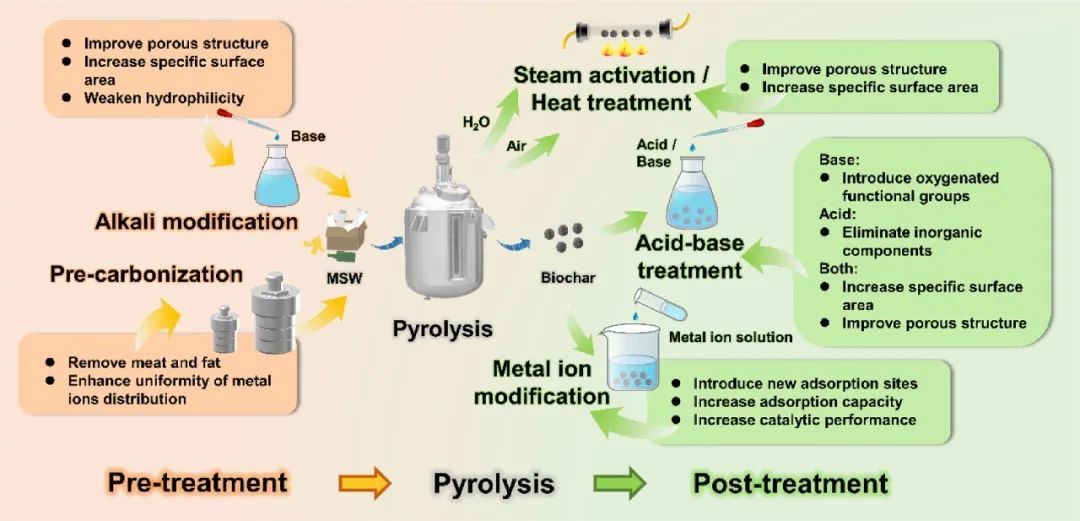
图1 垃圾衍生生物炭的制备工艺与性能
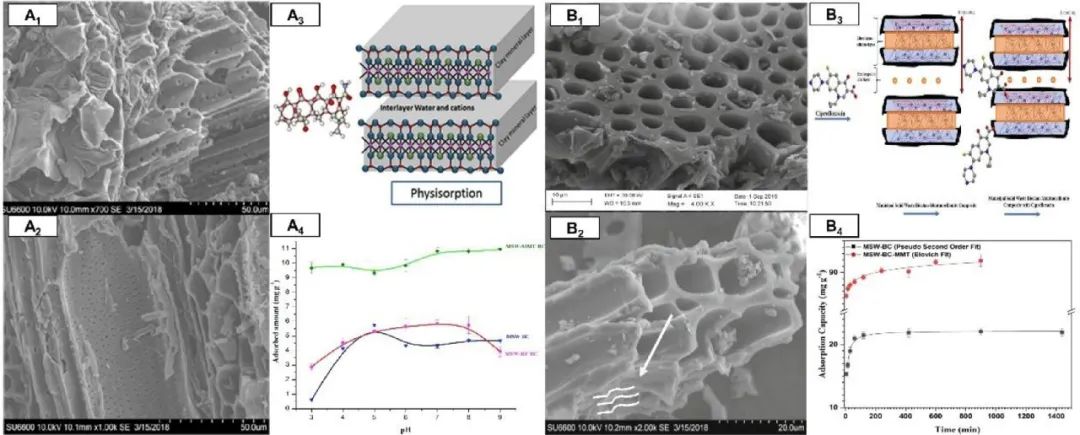
图2 (A1)原始生物炭的SEM图像:混合MSW衍生生物炭;(A2)粘土生物炭复合材料的SEM图像:MSW-BC-MMT复合材料;(A3)吸附系统的反应图;(A4)不同反应条件下,混合MSW衍生生物炭和MSW-BC-MMT的吸附能力;(B1)原始生物炭的SEM图像:混合MSW衍生生物炭;(B2)MSW-BC-MMT复合材料的SEM图像;(B3)粘土改性生物炭吸附污染物的反应图;(B4)混合MSW衍生生物炭和MSW-BC-MMT的吸附能力
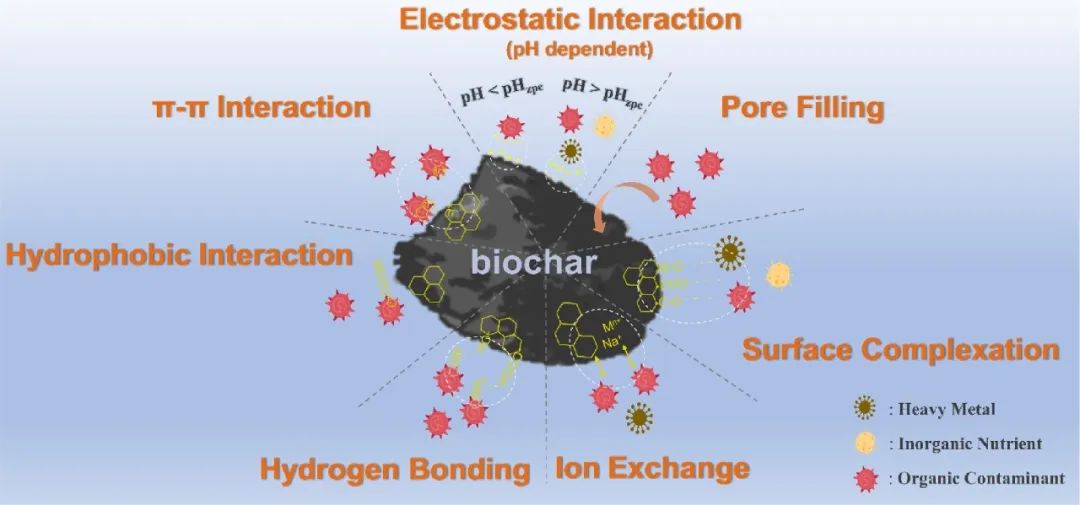
图3 垃圾生物炭吸附污染物的机理
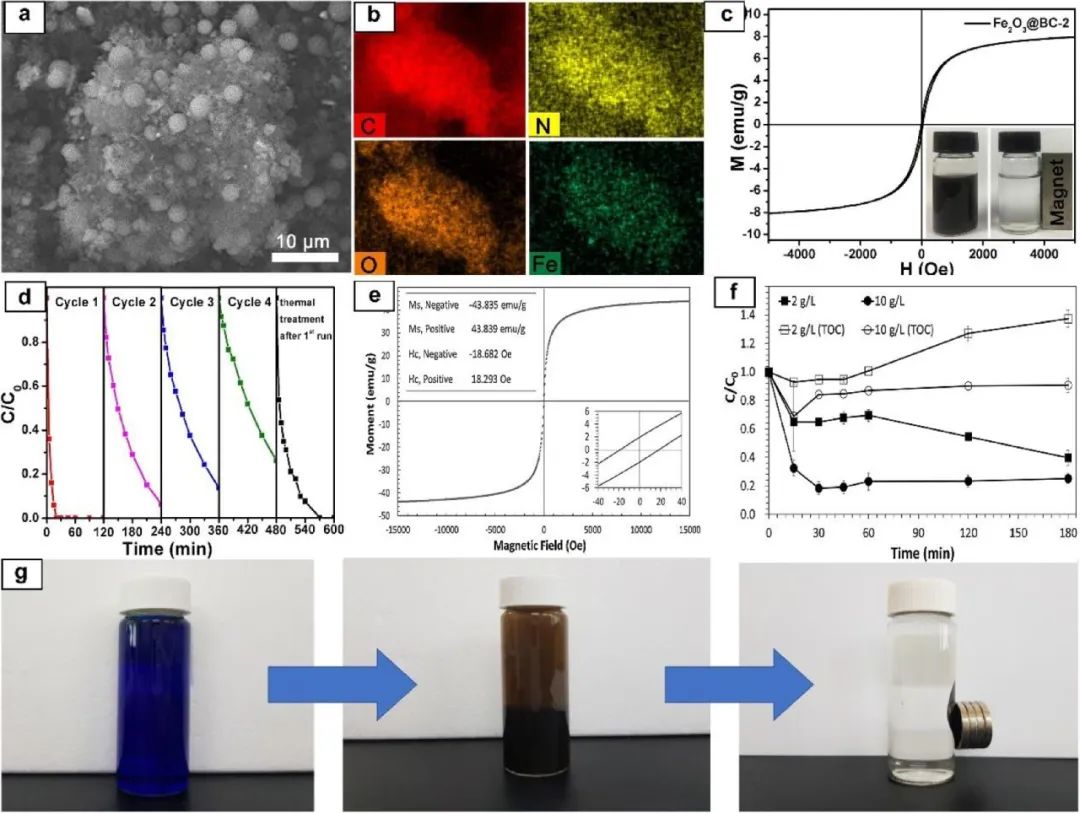
图4 (a)扫描电镜图像Fe2O3@BC;(b)元素映射图像Fe2O3@BC-2;(c)磁滞回线Fe2O3@BC-2;(d)γ的可重用性-Fe2O3@BC对于在PS存在下的BPA降解;(e)γ-Fe2O3/生物炭的磁滞曲线;(f)γ-Fe2O3/生物炭的磁滞曲线;(g)不同反应条件下纺织废水的颜色(λmax=600nm)和总有机碳的变化
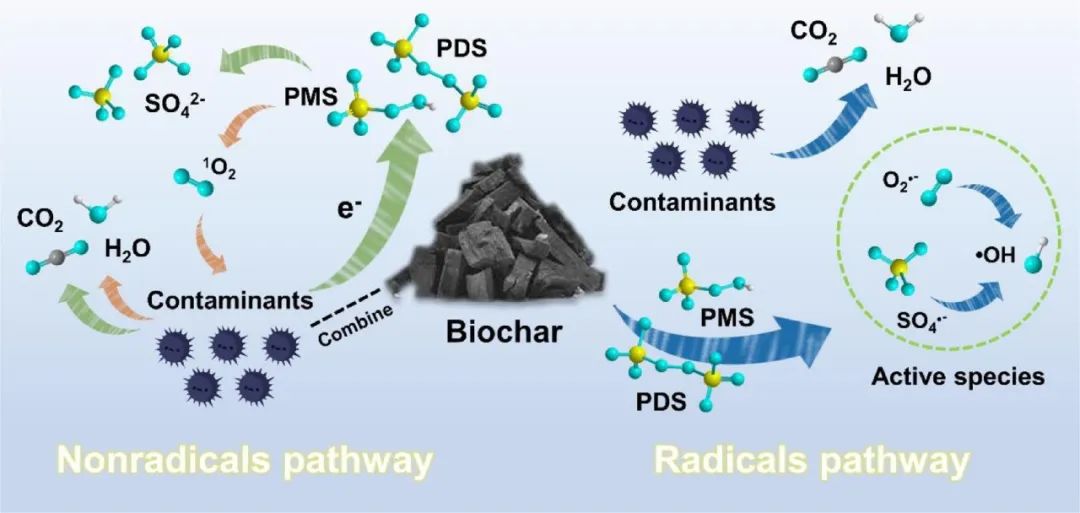
图5 垃圾生物炭活化聚苯乙烯氧化有机污染物的机理
原文信息
原文摘要
A huge amount of municipal solid waste (MSW) is produced with urbanization process, posing serious threats to the surroundings and human health. The preparation of MSW-derived biochar is an effective strategy for the waste reclamation. MSW-derived biochar possesses great potential in wastewater purification by adsorption and catalysis. In this review, biochar prepared from classified MSW (e.g. food waste and waste paper) was found with larger specific surface area and porosity than the mixed MSW-derived biochar. Meanwhile, pre-treatment and post-treatment means are summarized to improve the structure and composition of biochar, which could further strengthen its adsorption capacity and catalytic activity. The -COOH, -C=O, -C=C, -OH group sites and aromatic structure of MSW-derived biochar could adsorb pollutants through electrostatic interaction, surface complexation, ion exchange, hydrogen bonding and π-π interaction. Moreover, thanks to the -COOH, -C=O, -OH groups, N-doped structures, defective sites and iron ion species, the food waste-derived biochar exhibits excellent persulfate activation properties. Finally, the future challenges and research directions are suggested, which is conductive to promoting the resource utilization of MSW. Some consideration and recommendation about MSW-derived biochar for water treatment are provided, which facilitates the popularization of the innovative mode “waste control by waste” in aquatic environment remediation.