
2021-12-14
1
文章导读
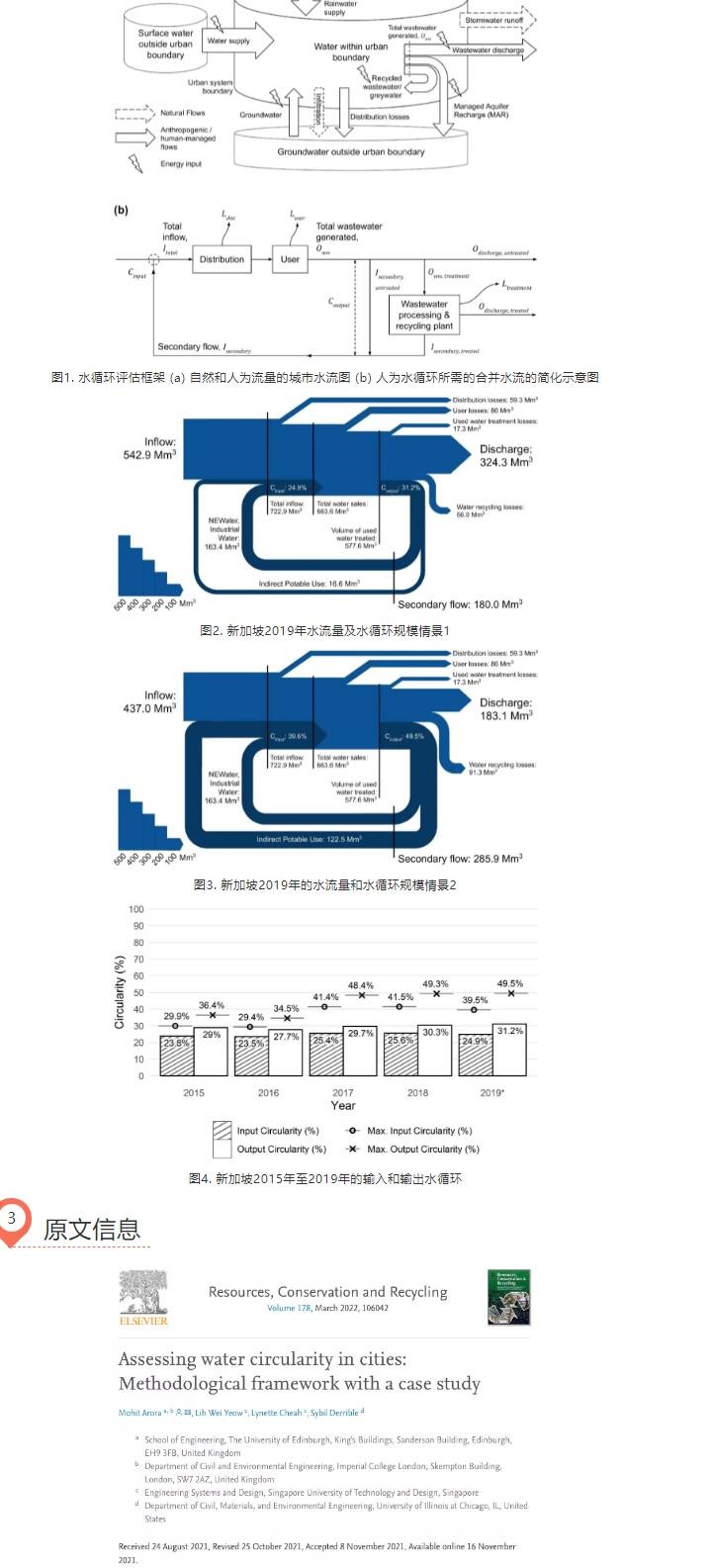
据统计,全球有超过40亿人每年至少有一个月面临严重的水资源短缺问题,超过20亿人生活在严重缺水的国家。降水强度和需求地点的时空变化会导致水资源短缺。循环经济旨在通过循环更有效的利用生产中的副产品以及报废的资源从而提高经济性。水循环是指在循环经济框架下更有效的利用水资源。目前少有研究对城市整体的水循环性进行定量评估。然而,随着饮用水的采购、处理和分配以及废水收集的成本不断提高,通过定量评估城市水循环性来制定更科学的城市宏观水系统规划迫在眉睫。基于此,本研究构建了一种量化工具来评估城市水循环性。
2
原文摘要
为提高城市循环水的利用,我们需要一个强大且可复制的框架来从系统的角度量化城市水循环性的程度及其影响。量化的城市水循环框架能够进一步帮助我们衡量城市间水循环政策的进展和影响。为此,我们将资源循环和物质流分析的概念结合起来,为城市开发一个需求和排放驱动的水循环评估框架。该框架整合了基于城市系统用水需求的人为水流量数据和用于用水需求替代的废水处理数据。我们采用该框架评估新加坡2015年至2019年的水循环状况。结果显示,新加坡的水循环性一直在稳步提高,2019年水循环满足了总需水量的24.9%,并有潜力达到39.6%的最大循环能力。最后,我们讨论了水循环评估对能源、环境和城市水基础设施的更广泛影响。本研究提供了一种量化工具来评估城市供水基础设施的水循环规模与辅助制定城市宏观水系统规划。
Abstract
With significant efforts made to consider water reuse in cities, a robust and replicable framework is needed to quantify the degree of urban water circularity and its impacts from a systems perspective. A quantitative urban water circularity framework can benchmark the progress and compare the impacts of water circularity policies across cities. In that pursuit, we bring together concepts of resource circularity and material flow analysis (MFA) to develop a demand- and discharge-driven water circularity assessment framework for cities. The framework integrates anthropogenic water flow data based on the water demand in an urban system and treated wastewater discharge for primary water demand substitution. Leveraging the water mass balance, we apply the framework in evaluating the state of water circularity in Singapore from 2015 to 2019. Overall, water circularity has been steadily increasing, with 24.9% of total water demand fulfilled by secondary flows in 2019, potentially reaching 39.6% at maximum water recycling capacity. Finally, we discuss the wider implications of water circularity assessments for energy, the environment, and urban water infrastructure and policy. Overall, this study provides a quantitative tool to assess the scale of water circularity within engineered urban water infrastructure and its application to develop macro-level water systems planning and policy insights.