
2021-12-08
图片来源于网络(侵删)
文章导读
2019年全球产生的电子废弃物约为5360万吨,预计到2030年将增加到7470万吨。亚洲产生的电子废弃物几乎占全球的50%(2490万吨),其次是美洲(1310万吨)和欧洲(1200万吨)。印度是第三大电子废弃物产生国,每年产生320万吨电子废弃物,只有1-2%被回收利用。在印度,电子废弃物作为主要的城市生活垃圾,并没有单独的收集系统,导致非法倾倒或焚烧,造成了严重的环境污染。
印刷线路板(PCB)是电子废弃物的主要组成部分,占电子废弃物总质量的4-7%,其贵金属含量的内在价值约为90%,尽管它只占0.01-1%的重量。PCBs的回收是至关重要的,既可以保护和替代原生资源,也可以减少碳和生态足迹。目前废弃PCBs回收的相关研究主要集中在湿法冶金、火法冶金、预处理、黄金回收等方面。然而,很少有学者关注整体的金属回收过程,尚未有研究PCBs的电子元件回收和终端产品增值过程。
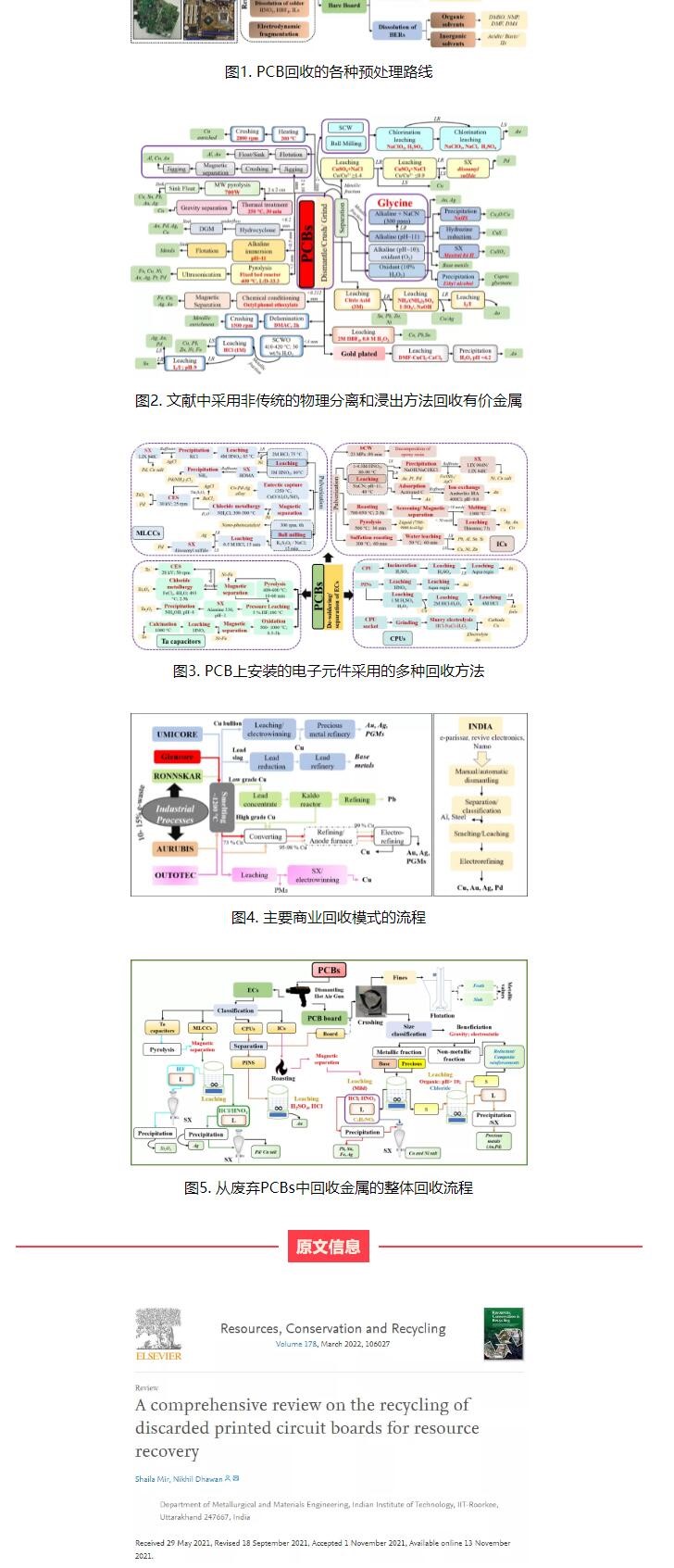
本文研究了包括预处理、金属富集和溶解/纯化的连续处理方法,对资源回收方法的最新进展和商业流程进行了深入研究。
文章亮点
1)预处理对金属价值的富集起着决定性的作用
2)基于火法冶金的回收技术是目前已达到商业规模的技术中最具优势的
3)讨论了电子元件和金属回收相关研究
4)从废弃PCBs中提取的增值产品最近得到了极大的关注
5)未来的回收前景是将贱金属成分和贵金属成分分开处理
原文摘要
印刷线路板(PCBs)是电子废弃物的重要组成部分。随着自然资源的迅速枯竭,由于大量报废的PCBs中蕴含着丰富的金属价值,对废弃PCBs的回收利用迫在眉睫。本文批判性地讨论了通过物理、火法冶金、湿法冶金和综合技术回收PCB金属的系统性和顺序性过程。预处理对金属的高效提取起着决定性的作用。为了提高分离效率和性能,部分研究将不同预处理方式和混合热化学路线相结合的新方法。采用溶剂萃取法、沉淀法、聚合物包合膜法、吸附法、离子交换法从多元素浸出液中选择性回收高纯产品是近年来研究的热点。基于火法冶金(冶炼-精炼)的回收技术是目前已达到商业规模的技术中最具优势的,其中电子废弃物只占全部原料中的一小部分。由于贵金属的存在,诸如单片陶瓷电容器、钽电容器、集成电路和安装在PCBs上的中央处理单元等电子元件非常重要。未来的回收发展方向是将贱金属成分和贵金属成分分开处理,使其环境影响最小,终端产品使用最小,经济效益最大。还应尝试将废弃PCBs转化为增值产品的可持续加工路线。本文提出了一种完整的、明确的废弃PCBs资源回收框架。
ABSTRACT
Printed circuit boards (PCBs) are an essential and central component of electronic waste. The rapid depletion of natural resources, massive generation of end-of-life PCBs and inherently metal-loaded values inevitably call for recycling and recovery. This review critically discusses the systematic and sequential processes adopted for PCB metallic recoveries via physical, pyrometallurgical, hydrometallurgical, and combined technologies. Pre-treatments play a decisive and significant role in upgradation and efficient metal extraction. A novel combination of different pre-treatments and hybrid thermal-chemical routes are often reported for improved separation efficiency and performance. Selective recovery (using solvent extraction, precipitation, polymer inclusion membrane, adsorption, ion exchange) of high purity product from multi-elemental leach solution has recently gained interest and is reviewed. Current recycling techniques at a commercial scale are preferably based on pyrometallurgy (smelting-refining), where electronic waste is only a fraction of the total feed stream. Electronic components such as monolithic ceramic capacitors, tantalum capacitors, integrated circuits, and central processing units mounted on the PCBs are important due to precious metals' presence. The futuristic recycling perspective should treat base and precious metal-rich components separately with minimal environmental effect, end product usage, and maximum economic benefit. Sustainable processing routes for converting discarded PCBs into value-added products should also be attempted, as amplified in this review. An integrated, definite framework for full resource recovery from waste PCBs was proposed.