
2021-06-07

图片来源于网络,侵删
文章导读
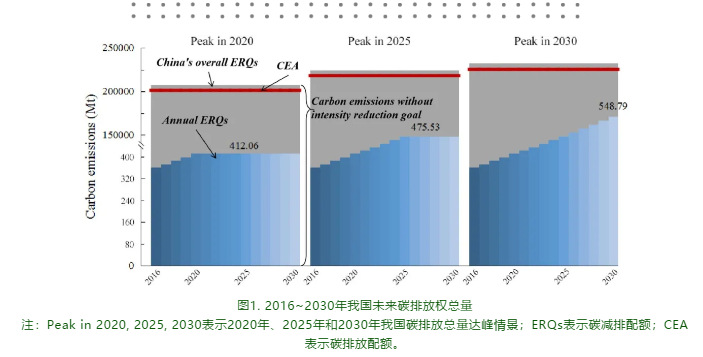
碳交易机制已成为有效调控温室气体总量、降低减排经济成本的重要政策工具。自我国2017年启动统一的碳交易市场建设以来,已有研究基于碳排放强度下降目标,实证分析了碳交易机制对降低我国碳减排成本的潜在贡献。然而,除碳排放强度下降目标外,我国还承诺在2030年前实现碳排放总量达峰。事实上,与强度下降的总量相对约束目标相比,强调总量绝对约束的达峰目标对我国未来碳排放的限制更为严苛。因此,将碳排放强度下降作为单一目标可能低估我国碳交易机制的潜在贡献。此外,初始碳排放权分配方案对省区碳减排及其交易策略的影响研究尚不充分,一定程度阻碍了碳交易市场的发展与完善。为此,本研究面向碳排放强度下降和总量达峰“双重”目标,模拟不同达峰情景下各初始碳排放权分配方案对省区间碳交易策略的可能影响,全面评估碳交易机制对降低我国碳减排总成本的潜在贡献。
文章亮点
(1)我们采用情景分析方法,模拟了中国在“双重”目标下的碳排放轨迹。
(2)采用非线性规划方法对我国碳交易机制进行模拟。
(3)将碳交易机制与“双重”目标挂钩可节省61.41%-80.33%的碳减排成本。
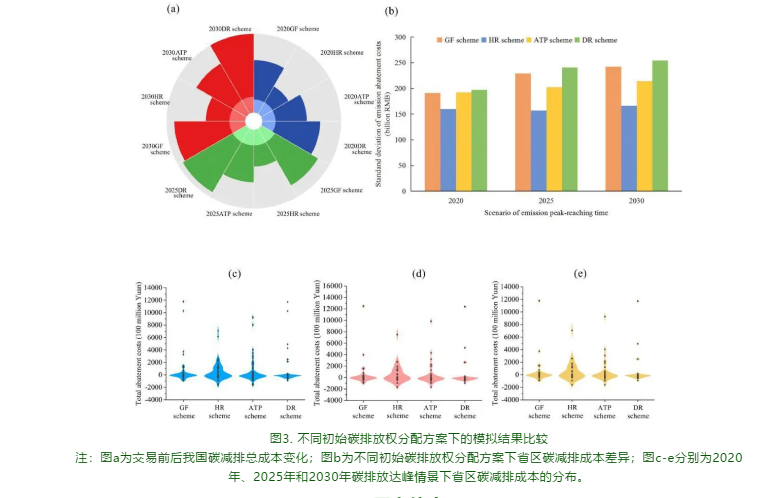
(4)在没有碳交易机制的情况下,“历史责任方案”的初始碳减排成本最低。
(5)在2030年实现碳达峰将为我国未来十年的经济增长创造更多空间。
原文摘要
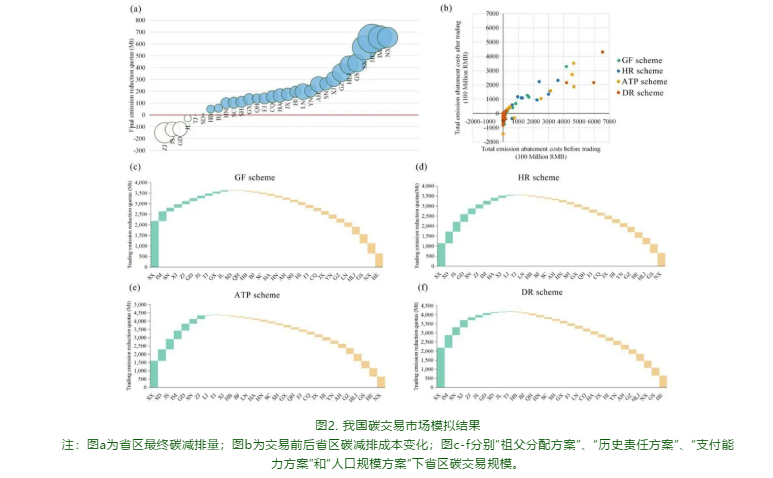
为实现全球温升控制目标,我国承诺“到2030年,中国单位国内生产总值二氧化碳排放将比2005年下降65%以上,力争2030年前二氧化碳排放达到峰值”。然而,碳交易机制作为实现上述强度和总量“双重”目标的重要政策工具,学界关于其对各省区未来碳排放水平及其减排成本影响的研究尚不充分,一定程度上阻碍了我国碳交易市场的发展与完善。本文以实现“双重”目标为导向,深入探讨碳排放达峰时间和经济增速对我国碳排放权总量的影响,并在拟合省区边际减排成本曲线的基础上,模拟不同初始碳排放权分配方案下的省区碳减排和碳交易策略。研究发现,省区间碳交易机制的运行将显著降低我国实现“双重”目标的经济成本,其成本降幅在61.4%~80.3%之间。为有效实现“双重”目标,省区间碳交易的理论价格须在394~425元/吨CO2之间。然而,过高的交易价格客观上可能制约碳交易机制的落实与推广。进一步与碳税、可再生能源发展等政策相结合,有望降低“双重”目标实现的碳价水平,推动全国碳交易市场发展。相比于2020年和2025年达峰,在2030年达峰将为我国释放更多的经济增长空间,而依据“历史责任方案”分配初始碳排放权则有助于缩小省区间减排成本差距、提升减排的公平性。此外,同时实现碳排放强度下降和总量达峰“双重”目标可能限制我国未来经济增速,适度提高2030年碳排放强度下降目标,不仅符合联合国关于“更新和收紧国家自主贡献”的倡议,亦能在一定程度上为我国未来经济增长腾挪出更多的空间。本研究不仅揭示了碳交易机制在降低区域碳减排成本中的重要作用,同时也为多重目标下的政策影响评估提供了科学可靠的分析框架,对于我国制定2030年前碳排放达峰行动方案具有重要的参考价值。
原文信息
Abstract
China has committed to goals of reducing its carbon intensity by 60%–65% in 2030 above the 2005 levels and peaking its carbon emissions by latest 2030. While a unified national emission trading scheme (ETS) has been recognized as the crucial instrument to fulfill these ambitious dual goals, its potential performance remains underexplored. This paper quantifies China's need for emission reduction under the dual goals in 2030 by setting three scenarios for peak emissions. Four initial allocation schemes of carbon emission allowance (CEA) are compared according to the emission abatement costs (EACs) of China and its 30 provinces. By estimating the provincial marginal abatement cost curves, China's ETS is simulated through a nonlinear programming aimed at minimizing its total EACs. We find that in achieving the dual goals it makes economic sense to operationalize the ETS that would reduce China's EACs by 61.41%–80.33% in 2016–2030, at a carbon price of 394.55–425.75 RMB per ton CO2. Peaking China's emissions in 2030 is the preferred choice that will trigger the largest GDP in 2016–2030. The historical responsibility scheme is recommended for the CEA allocation because of the lowest initial EACs without ETS. To allow more room for economic growth after China peaks emissions, there is a need for overfulfilling the goal of carbon intensity reduction by 2030, which is consistent with China's latest climate mitigation targets. This research not only highlights the role of ETS in realizing China's dual goals, but provides a scientific framework for evaluating the environmental policies towards multiple goals in a cost-effective manner.